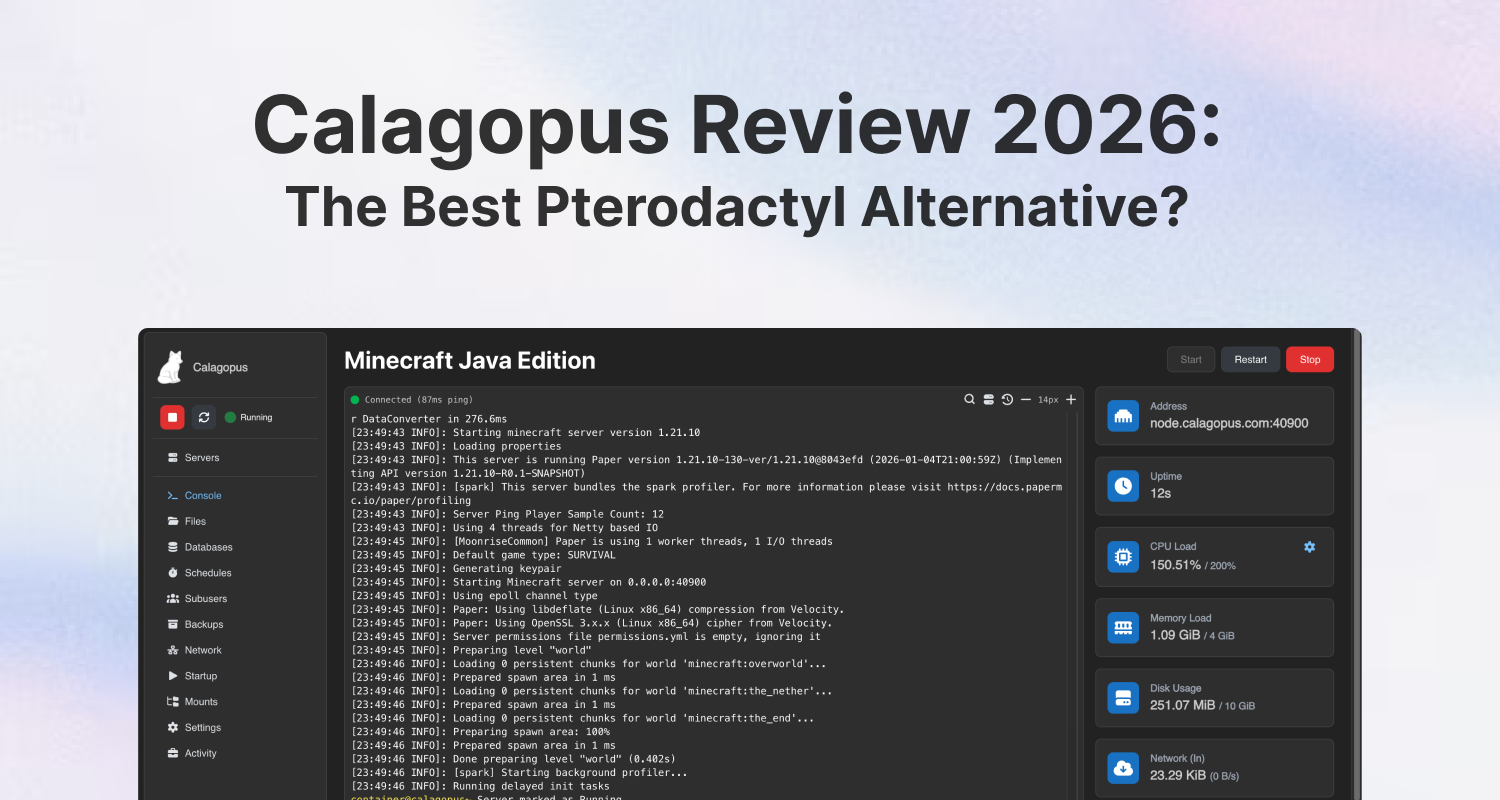
If you've been running game servers for any length of time, you know Pterodactyl. It's been the default choice for free, open-source game server management for years, and for good reason. But it also has limitations that have frustrated hosts for just as long.
A new open-source panel called Calagopus is looking to change that. Built from scratch in Rust and React, it is not a fork or a theme. It is a complete reimagining of what a game server panel should be in 2026.
This review covers everything: what Calagopus is, how it performs against Pterodactyl, what features it offers, who it's for, and whether it's worth switching to today.
What Is Calagopus?
Calagopus is a free, open-source game server management panel and a direct alternative to Pterodactyl. Rather than building on top of Pterodactyl's PHP/Laravel codebase, the Calagopus team rewrote everything from scratch using modern technologies chosen specifically for performance and maintainability.
The backend runs on Rust with the Axum framework, making it memory-safe, extremely fast, and lightweight. The frontend is built with React, Mantine, and Tailwind CSS, a modern stack that produces a clean, responsive interface for both admins and end users.
The project is MIT licensed, actively maintained, and already on version 1.0.2 as of April 2026, with over 1,650 commits and 74 releases behind it.
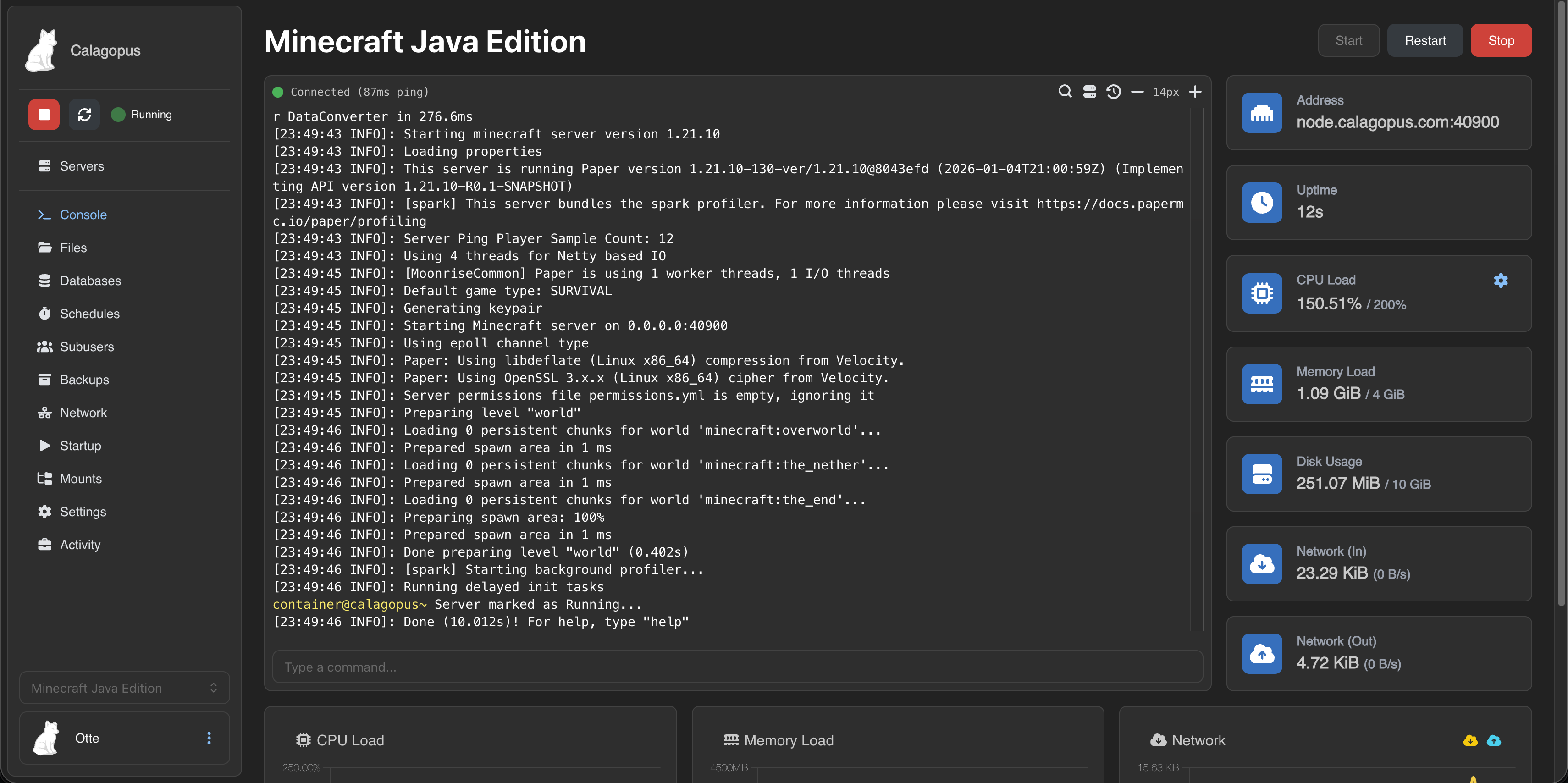
Calagopus Features
Core capabilities:- Deploy, monitor, and manage game servers in isolated Docker containers
- Full admin panel and user-facing client portal
- Plugin and extension system via Rust Traits-based Extension API
- Frontend extension support for custom UI modules
- OAuth login integration (GitHub, Google, Discord)
- Support for MySQL/MariaDB, PostgreSQL, and MongoDB
- Docker, binary, and package manager installation options
- Built-in migration path from Pterodactyl
- Paymenter module: official billing integration for automated server provisioning
- WHMCS module: official WHMCS billing integration
Calagopus Performance Benchmarks: How Fast Is It?
Performance is where Calagopus makes its strongest case. The team has published benchmarks comparing both panels under identical conditions.
Test setup: AMD EPYC 7443P, 4 threads, 4GB RAM, 500 concurrent connections.
Response Times
- Calagopus: 9.16ms average, 73.7ms worst case
- Pterodactyl: 1.30s average, 1.83s worst case
That's roughly 140x faster average response times. Calagopus also delivered 54,538 requests per second on that same hardware.
Memory Usage
- Calagopus idle: ~150 MiB
- Pterodactyl idle: ~296 MiB
Calagopus uses roughly 50% less memory at idle. For hosting providers running the panel on a smaller VPS alongside game servers, that's a meaningful real-world difference.
The performance gap is a direct result of the technology choice. Rust produces small, efficient binaries with no garbage collector and no runtime overhead, which gives Calagopus an inherent advantage over PHP-based alternatives.
Calagopus Wings: A Complete Stack Replacement
Calagopus doesn't just replace the panel. The project ships a full replacement for Pterodactyl Wings, also written in Rust. This means Calagopus is a complete, self-contained stack rather than a new UI bolted onto old infrastructure.
The Calagopus Wings replacement is designed for more speed, more features, and better long-term maintainability compared to the original Go-based Wings. It also ships with built-in support for FuseQuota, a custom FUSE-based disk quota system built specifically for Calagopus that provides accurate and performant disk limiting without the workarounds required by other approaches.
Calagopus vs Pterodactyl: Full Comparison
Where Calagopus Wins
- Performance: up to 140x faster response times in published benchmarks
- Memory efficiency: roughly 50% less memory at idle, which makes a real difference on resource-constrained servers
- Modern tech stack: the Rust backend provides memory safety, small binaries, and no runtime overhead
- Modern UI: built with React and Mantine, clean and fully responsive
- Extension API: built-in plugin system for both backend and frontend without needing to fork the codebase
- Complete stack: panel and Wings are both maintained together under a single project
- Active development: 74 releases and over 1,650 commits with regular updates
- Paymenter and WHMCS native: official billing modules are already available
- Multiple database support: MySQL, MariaDB, PostgreSQL, and MongoDB are all supported
Where Pterodactyl Still Leads
- Ecosystem size: years of community-contributed eggs, addons, and third-party tooling
- Community: a much larger user base with more guides, tutorials, and community support available
- Third-party integrations: more billing panels and tools have native Pterodactyl support out of the box
- Production track record: Pterodactyl has been battle-tested at scale for many years, and with Infraly LLC now managing the project, its long-term future looks more secure than ever
Installation and Migration from Pterodactyl
Calagopus supports three installation methods: Docker, binary, and package manager. The documentation at calagopus.com/docs covers each in detail, including environment setup, node creation, and egg management.
For existing Pterodactyl users, Calagopus provides an official migration guide covering both standalone and Docker-based Pterodactyl setups. This significantly lowers the barrier to trying Calagopus without building from scratch.
Is Calagopus Right for You?
Choose Calagopus if:
- You're starting a new game server hosting business and want the best available technology
- You're running on a small VPS and every MB of RAM counts
- You want a modern, extensible panel you can build plugins on top of
- You're already using Paymenter for billing and want a panel with a native integration
- You want to be ahead of the curve in the game server hosting space
Stick with Pterodactyl if:
- You have an established operation with years of Pterodactyl-specific tooling and third-party integrations
- You depend on integrations that only support Pterodactyl today
- You need the most battle-tested option available right now
- You're not comfortable adopting newer software in production
Frequently Asked Questions
Is Calagopus free?
Yes. Calagopus is completely free and open-source under the MIT license. Both the panel and Wings replacement are free to self-host with no licensing fees.
Is Calagopus stable enough for production?
Calagopus is on version 1.0.2 with 74 releases and over 1,650 commits. It is production-ready for new deployments. For large existing operations, test it thoroughly before migrating.
Does Calagopus support Pterodactyl eggs?
Yes. Calagopus supports both Pterodactyl and Pelican eggs, so you can bring your existing egg library with you when migrating.
Does Calagopus work with Paymenter?
Yes. There is an official Calagopus Paymenter module available on GitHub, enabling automated server provisioning through Paymenter's billing system.
Where can I get support for Calagopus?
The Calagopus team runs an active Discord community. The documentation at calagopus.com covers installation, configuration, and advanced topics.
Conclusion
Calagopus is the most technically ambitious Pterodactyl alternative to date. The benchmark numbers speak for themselves: 140x faster response times and 50% less idle memory. On top of that, it ships a complete Wings replacement, a Rust Traits-based extension API, official Paymenter and WHMCS billing modules, and a clean modern UI. This is a project that deserves serious attention.
Pterodactyl still leads on ecosystem maturity and community size. But for anyone starting fresh or looking to modernize their stack, Calagopus is the most compelling option available in 2026.
Enhance Your Hosting Setup with Paymenter
Running Calagopus alongside Paymenter for billing? BuiltByOtte builds high-quality Paymenter extensions covering file management, security, customer portals, and more.
- Security Addon: block users, IPs, and VPNs to protect against abuse
- Helpcenter: create a comprehensive knowledge base and FAQ system for your clients
- Statuspage: add a professional status page to keep clients informed
- Blog Addon: add a blog to your Paymenter site to drive organic traffic
View all our Paymenter extensions to find the right tools for your hosting business.
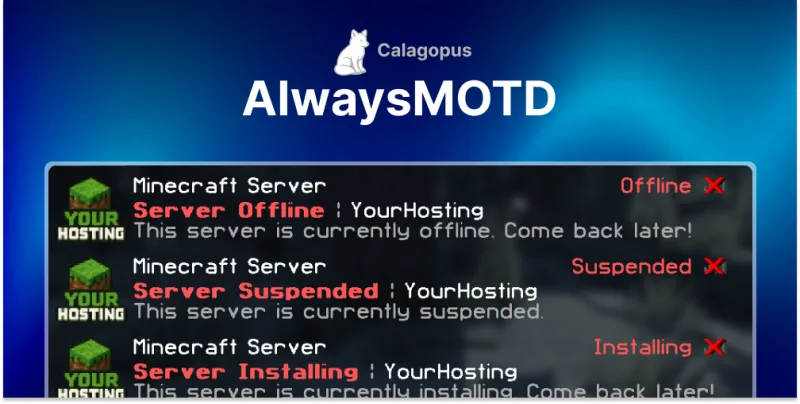 AlwaysMOTD Addon | Calagopus