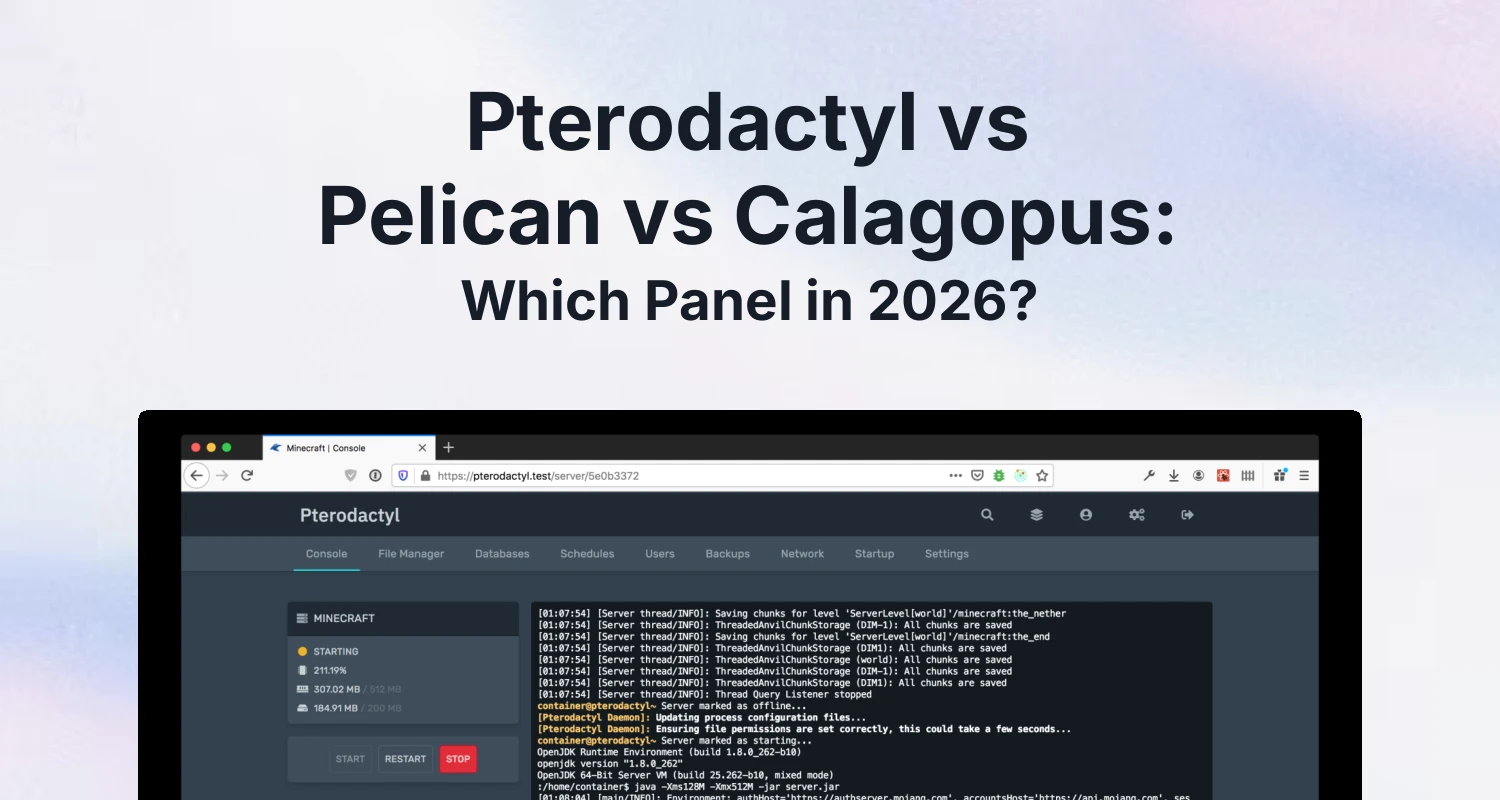
If you're choosing a game server panel in 2026, you have three real options: Pterodactyl, the panel almost everyone already runs; Pelican, a fork of it started by community maintainers; and Calagopus, a ground-up rewrite in Rust. The short answer is that all three run the same Docker containers and largely the same eggs, so the choice comes down to ecosystem size, plugin architecture, licensing, and how much you value raw performance over track record.
None of these is a one-way door, either. Because eggs carry over between them, you can trial a second panel on a spare node without abandoning the one you already run.
The three panels at a glance
| Panel | Stack | License | Egg compatibility | Status in 2026 |
|---|---|---|---|---|
| Pterodactyl | PHP/React panel, Go-based Wings daemon | MIT | Native (the original egg format) | Stable; latest tagged release is v1.15.1 |
| Pelican | PHP (Laravel), PHP 8.3–8.5 supported | AGPLv3, with a carve-out for private/unmodified use | Runs original Pterodactyl eggs unmodified | Still in beta; latest tagged release is v1.0.0-beta38 |
| Calagopus | Rust (Axum/Tokio) backend, React/Mantine/Tailwind frontend | MIT | Runs Pterodactyl and Pelican eggs, with built-in migration tooling | Actively releasing; see our full Calagopus review |
Pterodactyl: the default for a reason
Pterodactyl (pterodactyl.io) has been the standard open-source game panel since 2015. It pairs a PHP/React panel with Wings, a Go daemon that isolates each server in its own Docker container, and it's MIT licensed with fully open code. The project ships on a steady cadence: the panel and Wings are both at v1.15.1 as of their GitHub releases, and we cover what changed in that release in our Pterodactyl 1.15 update guide. If you're hardening a fresh install, our guide to enabling 2FA on Pterodactyl is worth a read too. Its own homepage still sums up why it caught on: it lets individuals and hosting companies run game servers at scale without expensive monthly fees, and the same codebase covers everything from a small friend group's server to a large commercial hosting operation.
The real argument for Pterodactyl in 2026 isn't the code, it's everything built around it: years of eggs, themes, and addons, including ours. AlwaysMOTD ($11.99, 144 purchases, 5.0/5 from 14 reviews) shows a live MOTD the moment a server is offline, installing, starting or suspended, and Security Scanner ($12.99, 5.0/5 from 8 reviews) checks hosted servers for malware and security issues. That depth of addon choice is the one thing a newer panel can't replicate overnight, no matter how the underlying code compares.
Pelican: the fork with a plugin system
Pelican (pelican.dev) started in 2024 when a group of Pterodactyl contributors forked the project over what its FAQ describes as "difference of visions, directions, and opinions," without any hostility between the two teams. It kept the same PHP/Laravel foundation and Docker-per-server model, but rebuilt the plugin system: instead of patching panel source files by hand the way Pterodactyl add-ons like Blueprint do, Pelican aims for installable plugins and themes that survive an update. Its FAQ lists a genuine plugin system, planned automatic updates, and future Podman and Kubernetes support as the features driving the fork, and it's explicit that Blueprint extensions are not compatible with Pelican's architecture.
Two things are worth knowing before you commit. First, licensing: Pelican relicensed from MIT to AGPLv3. Per its FAQ, that only actually bites if you modify the panel's core source, keep those modifications closed, and run that modified version publicly — a commercial license covers that case. Running an unmodified copy, or building plugins and themes for it, stays free, and private panels aren't affected by the restriction at all. Second, maturity: Pelican is still officially in beta, with v1.0.0-beta38 as its latest tagged GitHub release, so treat it as a panel to pilot on a non-critical node rather than a drop-in swap for a production Pterodactyl install just yet.
On compatibility, the news is good: Pelican's FAQ states that original Pterodactyl eggs will keep working indefinitely, even as newer egg formats are developed, so your existing egg library isn't a reason to stay put or a reason to switch.
Calagopus: the Rust rewrite
Calagopus (calagopus.com) takes a different approach: rather than forking Pterodactyl's PHP codebase, it's a ground-up reimplementation in Rust, using the Axum web framework and Tokio runtime on the backend with a React, Mantine and Tailwind frontend. It's MIT licensed, and its own Wings-equivalent daemon is also written in Rust rather than Go. We've already covered its performance claims and installation steps in depth in our Calagopus review and our guide to migrating from Pterodactyl to Calagopus, so we won't repeat the numbers here — what matters for this comparison is that its GitHub repository confirms it runs both Pterodactyl and Pelican eggs unmodified, with migration tooling built into the panel itself. If you already sell or run add-ons for Pterodactyl, our AlwaysMOTD Addon for Calagopus brings the same offline/installing/starting/suspended MOTD behaviour to a Calagopus install, at a lower $4.99 price point that reflects how new the Calagopus marketplace still is.
Licensing, in plain terms
Pterodactyl and Calagopus are both MIT licensed, which is about as permissive as an open-source license gets: fork it, modify it, resell hosting built on it, no obligation to share your changes back. Pelican is the outlier, having relicensed from MIT to AGPLv3. In practice that only matters for a narrow case: per Pelican's FAQ, you only need a commercial license if you modify the panel's core source, keep those modifications proprietary, and then run that modified version publicly. If you run an unmodified copy of Pelican, or build plugins and themes for it (rather than editing the core), you're not affected, and private panels aren't affected by the restriction at all. It's worth reading the FAQ yourself before you plan any deep customization, but for most hosting providers running any of these three panels as-is, licensing isn't a practical blocker either way.
What migrating between them actually looks like
Because eggs are the shared currency, none of these moves require rebuilding your server catalog from scratch. Calagopus's own repository advertises migration tooling built into the panel for importing existing Pterodactyl or Pelican installs, and we walk through that process step by step in our Pterodactyl-to-Calagopus migration guide. Pelican's FAQ is less specific but commits to a guide that its maintainers say will be at least as easy as a normal Pterodactyl version upgrade. Either way, the safer path for a production host is the one we suggested above: stand a second panel up on a spare node first, with a copy of your egg library, and confirm your specific game servers behave the way you expect before touching anything customers depend on.
So which one should you actually run?
There's no single right answer, but the deciding factors are consistent:
- You want the biggest addon and theme selection, today: stick with Pterodactyl. Its age is a feature here, not a drawback.
- You want a modern plugin system without leaving the PHP/Laravel world, and you're comfortable running beta software on a non-critical node first: pilot Pelican, and read its AGPLv3 terms before you plan to fork and closed-source anything.
- You care most about raw throughput and low idle resource use, and you're willing to be an earlier adopter of a newer codebase: Calagopus is the one built for that, and it already imports eggs from both of the others.
Because all three speak the same egg format, the lowest-risk way to decide is to stand up a second panel on a spare node, point it at the same egg library, and see which one your team actually prefers running day to day.
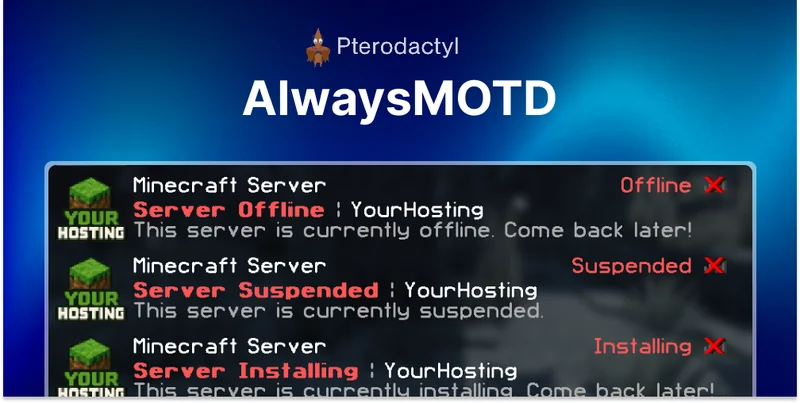 AlwaysMOTD Addon | Pterodactyl
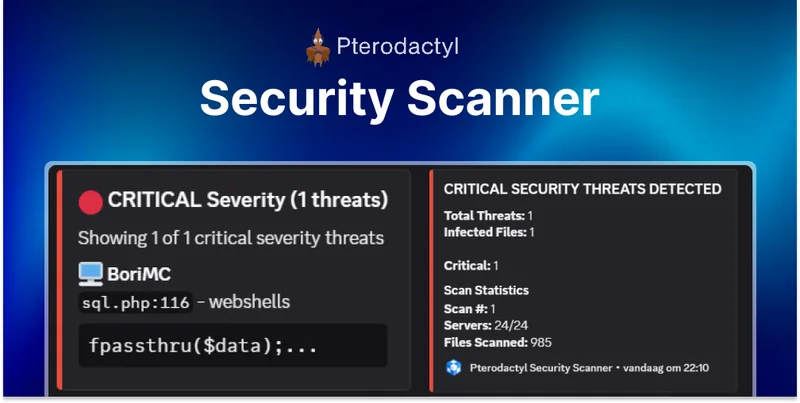 Security Scanner | Pterodactyl