Pterodactyl v2 is out as an early alpha, and you can install it today from the 2.0-develop branch on GitHub. There is no tagged release yet, so treat it as a test build. The headline changes are an Extension SDK that lets you extend the panel without editing core files, a rebuilt frontend on React 19 and Laravel 13, one combined React app for the admin and client areas, a one-click egg importer, and theming through design tokens. It stays MIT licensed and free.
For hosting providers the practical answer is: keep running the stable 1.x line in production, but start planning now. According to an announcement in the Pterodactyl Discord, 1.x will receive security updates for about six months, possibly longer depending on the severity of an issue. Use that time to check which of your addons and themes edit core files, make sure your servers can run PHP 8.3, and try v2 on a test machine. Below we go through what the alpha contains, what is still unclear, and a preparation checklist.
Where Pterodactyl v2 stands right now
In the Pterodactyl Discord, the team describes 2.0 as out in its first alpha. On GitHub that alpha is the 2.0-develop branch: its README says v2 is under active development and still names 1.0-develop as the stable release line, and the changelog lists v2.0.0 as unreleased, built against Extension SDK 2.0.0-beta.4. The branch is moving fast: several commits landed on 6 October 2026 alone, including a React upgrade and fixes for extension translations and the server console. The official extensions repository was created on 5 October 2026 and published its first release, v1.0.1, the next day.
The newest stable release is still Panel v1.15.1, published on 14 August 2026, and the newest Wings release is Wings v1.13.3, from the same day. There is no v2 tag on the releases page yet and no announced date for a stable v2. The Discord announcement says 1.x keeps getting security updates for about six months, and potentially longer depending on how severe a security issue is.
The README also links a video thumbnail labelled as an introduction to v2. On YouTube that video is titled Something new is landing. If you want the backstory around that teaser and the community drama that followed, we covered it in The Pterodactyl situation, explained. This post sticks to the code.
One trap to avoid: the repository also has an old branch simply called v2. Its latest commit is from April 2022, and it is not where today's v2 work happens. If a script or Composer constraint points at v2.x-dev, check what it is actually pulling.
What's new in Pterodactyl v2
An Extension SDK instead of core edits
This is the change that matters most for anyone selling or running addons. According to the README, v2 lets you extend the panel through a versioned API instead of editing core files, so changes survive updates. The SDK README goes further:
- Extensions register components into named slots (the example uses
server.console.before) and add their own screens to the server, account or admin areas, declared in anextension.jsonmanifest. - Extensions can register their own subuser permissions, named
ext.<id>.<key>, which show up in the server's user editor. - Everything exported from
@pterodactyl/sdkis semver-governed: additions are minor versions, removals are majors. That is the promise that should stop updates from breaking addons. - Each slot has its own error boundary, so a crashing extension should not take the whole page down. The README is honest that this is not a sandbox: native extensions still run in the panel's JavaScript environment.
- Enabling, disabling or updating an extension takes effect on the next full page load.
On the backend, the changelog lists action contracts that extensions can call and wrap (file reads, directory listings, server logs, live server state, egg changes and login completion), plus hooks to register commands, schedules, head tags and root routes. Extension settings get colour, textarea, multiselect, list and file fields, with uploads served from /extension-files/<id>/.
There is also a conflict rule worth knowing about. Each extension that uses Tailwind must declare its own prefix of 2 to 12 lowercase letters, two enabled extensions cannot share one, and the panel rejects builds whose utilities do not carry the declared prefix. In plain terms: one extension's CSS should no longer break another's layout, which anyone who has stacked several v1 addons will appreciate.
Official extensions and how you install them
The Pterodactyl team publishes example extensions in pterodactyl/extensions. Right now there are four:
- Announcements: panel-wide banners users can dismiss.
- Custom Buttons: admin-defined link buttons and sidebar items on the server page.
- Dark Theme: a deeper neutral dark theme that also works as a template for your own.
- Redirect: short links served by the panel, such as
/go/discord.
Installing one is a single command on the panel host, after downloading its zip from the latest release:
php artisan p:extension:install /path/to/dark-theme.zip --enableThen reload the panel. Extensions can be disabled or removed again from Admin > Extensions. Note that the same README says the SDK is not published to npm yet, so developers currently build against a local clone of the 2.0-develop branch.
The official extensions also show the minimum requirements in practice: each one's extension.json asks for panel ^2.0.0-dev, SDK ^2.0.0-beta.4 and PHP ^8.3.
A modernised stack and a single React app
The README lists Vite, React 19, TanStack Router and Query, Tailwind 4 and Laravel 13, and says the admin and client areas are now a single React application with one design. If you have spent years with the old separate admin area, this is the biggest visible change.
Egg importer and design-token theming
Two smaller features with real day-to-day value: a one-click egg importer that lets you browse the egg catalog and import directly from the panel, and theming with design tokens so you can restyle the panel without rebuilding it. The changelog shows how far the token system already goes, with tokens for layout, terminal, selection, scrollbars and browser chrome, plus an optional sidebar sub-navigation mode.
Pterodactyl v1 vs v2 at a glance
| Pterodactyl 1.x (stable) | Pterodactyl v2 (2.0-develop) | |
|---|---|---|
| Status | Stable, v1.15.1 released 14 August 2026; security updates for about six months | Early alpha, installable from 2.0-develop; no tagged release |
| PHP requirement (composer.json) | 8.2 or 8.3 | 8.3 |
| Laravel | 12 | 13 |
| Frontend | Separate admin and client areas | One React 19 app for admin and client, Tailwind 4 |
| Addons | No official extension API; addons edit core files | Official Extension SDK with a versioned API |
| Theming | Not listed as a feature | Design tokens, no rebuild |
| Egg catalog importer | Not listed as a feature | One-click import from the panel |
| License | MIT | MIT |
The PHP and Laravel rows come from the 1.0-develop composer.json and the 2.0-develop composer.json. The v2 package.json also asks for Node.js 22 or newer, which matters if you build the frontend yourself.
What we could not confirm yet
A lot of what hosts want to know is simply not written down anywhere we could find. Rather than guess, here is the list:
- Stable release date. The alpha is public, but there is no date for a stable v2 in the README, changelog or releases page.
- Upgrade path from 1.x. We found no v2 upgrade guide. The panel documentation links in the README still point to the 1.0 docs.
- Wings. The newest Wings release is v1.13.3, and we found nothing saying whether v2 needs a new Wings version.
- Existing addons and themes. Nothing we read says v1 addons, Blueprint extensions or edited themes will carry over. Since v2 replaces most of the frontend, assume anything that patches core files will need a rewrite until the developer says otherwise.
How to prepare your hosting business for v2
- Stay on 1.x in production, and put a date in your calendar. The README calls 1.x the stable line and v1.15.1 is current. Security updates for 1.x are planned for about six months, so aim to have your v2 plan ready well before then. Test the alpha on a separate machine, never on the panel your customers use.
- Get onto PHP 8.3. v1 already supports 8.3, so you can move now and remove one variable from the eventual upgrade.
- List every modification you run. Write down each theme, addon and Blueprint extension, and note which ones edit core files. Those are your migration risk, and the people to ask are their developers.
- Keep your customisations in one place. If you patched the panel yourself, keep those changes in a git branch or a patch file. Reapplying them, or rebuilding them as an extension, is much easier when you know exactly what you changed.
- Try the official extensions. Announcements, Custom Buttons and Redirect cover small tweaks many hosts currently do by hand. They are a good way to see how the extension model feels before anything important depends on it.
- Back up before any major upgrade. Database dump,
.envfile (with yourAPP_KEY) and server data. This is standard advice, but a major version is when it counts.
What this means for Pterodactyl addons, including ours
We sell three Pterodactyl resources: AlwaysMOTD ($11.99), which instantly shows if a server is offline, installing, starting or suspended, Security Scanner ($12.99), which helps protect your hosting from possible malware and security issues, and Advanced Pterodactyl ($4.99), which adds a quick overview, single sign-on and custom server names. They are built for the current 1.x panel. We have not announced v2 versions, and we will not promise anything while v2 is in alpha and the SDK is still in beta. If you rely on one of them and want to know our plans, ask us in the Discord community.
Honestly, a versioned extension API is good news for addon developers too. Fewer core edits means fewer support tickets after every panel update. Until a stable v2 ships, though, the free official extensions are the safest way to try the new model, and they cost nothing.
If the uncertainty makes you want to look at other panels, we have a Calagopus review and a guide to migrating from Pterodactyl to Calagopus. We would not switch only because of v2, though: on paper it fixes the biggest long-standing complaint about Pterodactyl, which is that customising it means patching code that the next update overwrites.
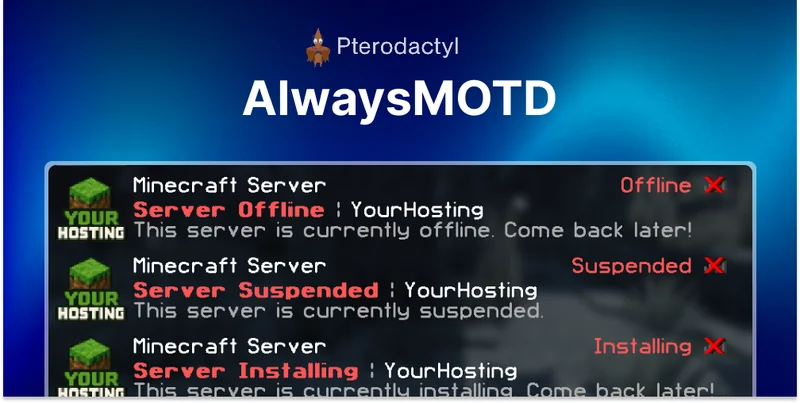 AlwaysMOTD Addon | Pterodactyl
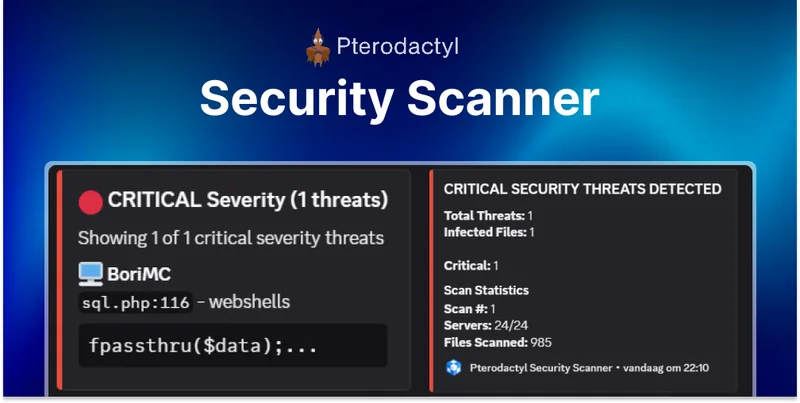 Security Scanner | Pterodactyl