If your Paymenter store is losing customers, the fix usually isn't a better price or a flashier landing page — it's the handful of moments where a customer decides not to continue: the renewal they don't complete, the checkout they abandon, the "cancel" button they click because there was no easier option. Hosting and game server billing runs on Paymenter's subscription model, so every one of those moments is a place where a small change can keep revenue that would otherwise walk out the door.
This guide looks at three of those moments — cancellation, renewal, and checkout — and what the research says about fixing each one, plus the Paymenter addons built specifically for them. None of it requires touching your prices or your product; it's about removing friction at the points where customers are already deciding whether to stay.
Do you need an addon, or can you do this manually?
Before adding anything to your store, it's worth being honest about what a small operation can already do by hand. If you only have a handful of customers, you can pause a service manually when someone asks, issue a one-off discount code for a longer commitment, or send a personal follow-up email to someone who didn't finish checkout. None of that costs anything beyond your time.
Where a manual approach breaks down is scale and consistency: it only works if you notice the abandoned cart, remember to follow up, and are online when the request comes in. The addons below don't do anything a human couldn't do — they just do it automatically, for every customer, every time, which is the point once your store has more than a few dozen active subscriptions.
Start with the churn you don't see: failed payments
Before touching cancellations, it's worth checking the churn that never shows up as a deliberate decision. Failed card payments — not customers choosing to leave — account for an estimated 20–40% of total subscription churn, according to Baremetrics' analysis of involuntary churn, which cites research from Paddle. The same article puts the average unrecovered revenue loss at around 9% of monthly recurring revenue for subscription businesses that don't actively work the problem.
The fix isn't a Paymenter addon, it's your payment gateway's retry and dunning settings. Baremetrics notes that pre-dunning emails sent about 30 days before a card expires average roughly 73% open rates, and that combining retries with proactive card-expiry reminders and multi-channel notifications can cut involuntary churn by 30–50% compared with doing nothing. If you haven't looked at your gateway's retry logic recently, that's the highest-leverage five minutes you can spend before reading the rest of this post.
Give people a pause button before they hit cancel
Once payments are being retried properly, the next leak is voluntary cancellation — and a large share of it isn't really about wanting to leave. Recurly's 2026 State of Subscriptions report, summarized in Recurly's guide to cancellation flows, found that about 38% of subscribers would rather pause a subscription than cancel it outright, but only 37% say they're actually offered that option. Where businesses added a pause-before-cancel step, pause usage jumped 337%, and roughly three in four subscribers who paused came back within a few months. Across the subscription industry, letting would-be cancellers pause instead has generated more than $200 million in re-subscription revenue.
Paymenter doesn't include a pause option in its core, which is exactly the gap the Service Pausing addon fills: it lets your customers pause a service for a while instead of cancelling it, with limits you set on how long or how often. At $7.99 it's a small addition next to what a single saved cancellation is worth, and the Service Pausing documentation covers how the limits work.
Make renewing the path of least resistance
Every renewal is another decision point, and every decision point is another chance for a customer to lapse — a card declines, they mean to renew next week and forget, or they simply lapse. One way to cut the number of those moments is to let customers commit to several billing periods at once instead of one at a time.
That's what the RenewAhead addon does for Paymenter: customers can renew a service for several billing periods in one go, with discount tiers you configure to make the longer commitment worth it. It won't fix a broken payment method, but it does mean a customer who's happy with your service today can lock in months of continuity in one action, rather than facing that same renew-or-not decision every cycle. It's priced at $7.99, and setup is covered in the RenewAhead documentation.
Recover the customers who almost signed up
Not all churn happens after someone becomes a customer. A lot of it happens before checkout even finishes. Baymard Institute data, cited in Mailmodo's cart abandonment statistics guide, puts the average cart abandonment rate across industries at around 70%, rising to about 85.65% on mobile devices. That's revenue your store already attracted and then lost at the last step.
The same guide reports that when businesses send abandoned cart recovery emails, an estimated 29.9% of those emails get clicked (data from SaleCycle), and that sending a short series of follow-up emails recovers more carts at a better return than sending just one (data from Rejoiner). For a Paymenter store, that's the job of the Abandoned Carts addon: it emails customers who left items in their cart, with a one-click link that restores the cart so they can finish where they left off. It's also priced at $7.99, and the Abandoned Carts documentation walks through setting up the email sequence.
Comparing the three levers
| Addon | What it targets | Price | Best for |
|---|---|---|---|
| Service Pausing | Customers about to cancel who just need a break | $7.99 | Cutting voluntary cancellations |
| RenewAhead | Customers facing a renewal decision every cycle | $7.99 | Reducing renewal-point churn |
| Abandoned Carts | Visitors who started checkout but didn't finish | $7.99 | Recovering lost signups before they ever churn |
None of the three overlaps with the others: pausing keeps existing customers, RenewAhead keeps them for longer per action, and Abandoned Carts brings back people who never became customers in the first place. You can run all three independently, and none of them requires you to change how the others work.
A short checklist to start this week
- Check your payment gateway's dunning and retry settings first — this is the churn you're already paying for and not seeing.
- Turn on a pause option before your cancellation flow, so customers who just need a break don't have to fully cancel.
- Add one or two RenewAhead discount tiers so loyal customers can commit to multiple periods in a single decision.
- Set up an abandoned cart email sequence rather than a single message — the research consistently favors a short series over one email.
- Review the numbers after a full billing cycle, since pause and renewal effects only show up once a cycle has actually passed.
None of this replaces good service or fair pricing — if customers are leaving because the product isn't working for them, an addon won't fix that. But for the share of churn that comes from friction rather than dissatisfaction, these are the three points in the Paymenter customer journey where a small change tends to matter most.
Why this matters more for recurring revenue than for one-off sales
A one-time purchase either happens or it doesn't. A subscription has to survive every single billing cycle to keep paying you, which is why the same small leak compounds over a year of renewals in a way it never would for a single sale. A customer who churns in month three doesn't just cost you that month's invoice; it costs every renewal they would otherwise have paid afterward. That's also why the fixes above are worth trying roughly in the order they're listed: recovering a failed payment or a paused subscription keeps a relationship that already exists, which is generally cheaper than acquiring a brand-new customer to replace it.
If you're only going to do one thing after reading this, check your payment gateway's retry settings first — it's free, it takes a few minutes, and based on the Baremetrics figures above it's likely where the largest share of your unnecessary churn is currently happening unnoticed.
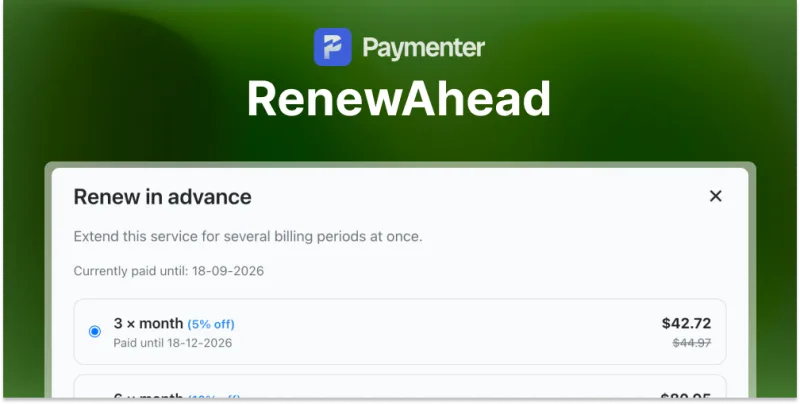 RenewAhead | Paymenter
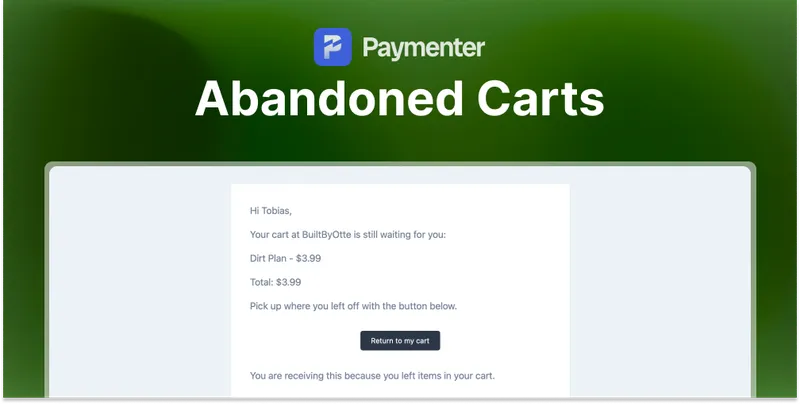 Abandoned Carts | Paymenter
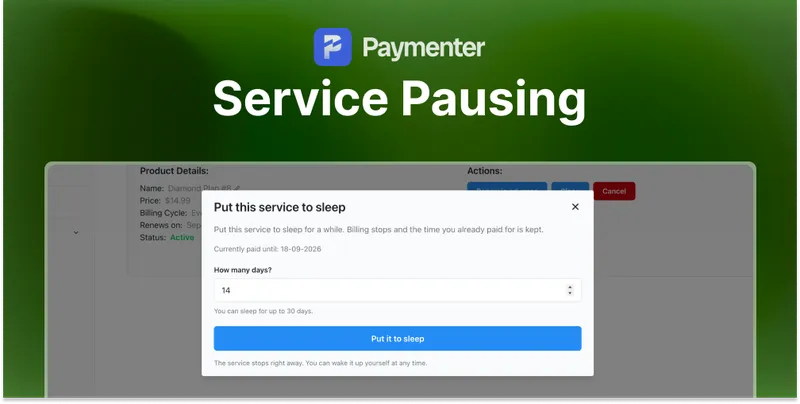 Service Pausing | Paymenter